Last week we built your content funnel by breaking it down into the three key stages of audience awareness of your brand as:
- Top of Funnel = Problem -> Solution aware
- Middle of Funnel = Solution -> Brand aware
- Bottom of Funnel = Brand -> Offer aware
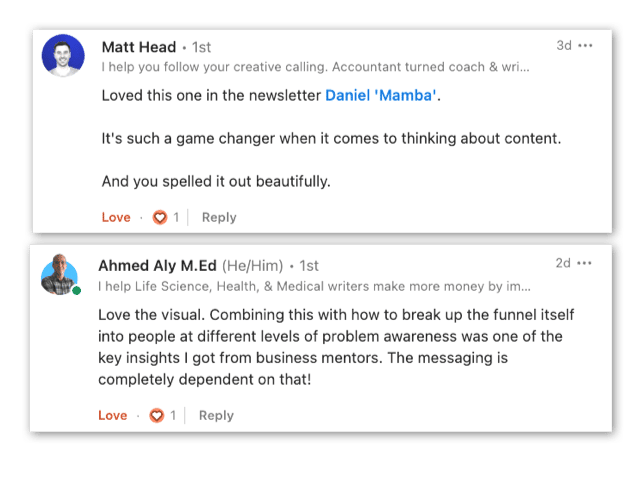
Plenty of people have found that visual really helpful in giving an overview and understanding of their overall content strategy.
However, for many of you reading this, you may not have started creating content because you're unsure what to focus on for your brand's content.
As I believe that direction is more important than speed, it's crucial that you invest time upfront to plan the direction of your content and then take massive action towards creating content aligned with that direction.

Because even if you're driving your car as fast as you can, if you've set the wrong destination at the start, you'll end up being miles away from where you actually want to end up and have wasted a tonne of fuel (i.e. time & energy) getting there.
That's a recipe for burnout.
Sidenote: This analogy doesn't just apply to content creation but to life
So this guide is designed to prompt you with the What, Who and How of each piece of content you create so that you gain massive clarity on your direction.
Alright legend, let's get your content aligned!
Your Content Trinity
This visual represents the 3 clarifying questions to answer each time you create content.
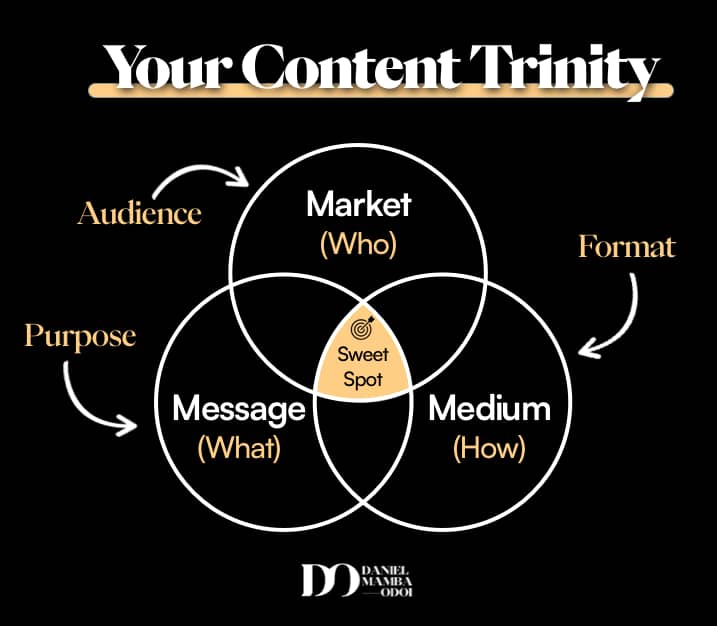
Your focus is to build a sustainable system that lets you consistently create content at the intersection of your 3Ms, a.k.a. "The Sweet Spot."
1. Message
Q: What is the purpose of this content?

Before you make any piece of content, you need absolute clarity on its purpose, which will be guided by which stage of your content funnel it sits within.
Do you want your content to:
- Educate: solve a problem?
- Spread: be widely shared?
- Inspire: motivate and uplift?
- Engage: encourage an action?
- Entertain: put a smile on the dial?
- Relate: connect on a personal level?
Why does this matter?
Creating content is an investment of your time and energy, so you want to ensure you're not wasting your energy creating content that doesn't contribute to your brand's broader vision and mission.
Now that you're clear on WHAT the purpose of your content, it's time to focus on the recipient of it.
2. Market
Q: Who is the audience for this content?
This prompts you to see your content from the eyes, ears and headspace of the person you're serving and supporting.
Again, if you're clear on your audience's level of awareness as guided by your content funnel, you'll better understand their relationship to you.
Are they:
- Discovering you for the first time?
- An existing, loyal follower or subscriber?
- A beginner, intermediate or advanced level in your topic?
- Considering whether they want to engage with you or not?
- Familiar with your brand but don't have a personal connection?
Why does this matter?
I'm going to be controversial here.
I don't believe in:
"Treating people how you want to be treated."
That's selfish.
It doesn't factor in the other person.
Instead, I believe in the following:
"Treat people how they want to be treated." — Mamba
Remember — good communication is about meeting your audience where they're at.
The better you can connect with them and make them feel understood, the more likely they'll respond favourably.
Now, let's nail the delivery of your content so that it lands well with your audience every time.
3. Medium
Q: How are you delivering it?
With your content's purpose (what) and audience (who) aligned, you finally need to decide on the most effective format for delivering your message in a way that:
- Plays to your natural strengths as a storyteller; and
- Reflects how your audience consumes content
I'd need a separate guide to break down each and every content format in existence, so for now, here are the overall categories that you can consider using as the format or "container" for your content:
- Written: captions, Tweets, newsletters
- Video: talking heads, screen recordings, animations
- Audio: podcasts, voice notes, music
- Graphics: carousels, thumbnails, e-books
Why does this matter?
If you've created content to communicate a message, and your audience doesn't understand it or respond the way you intended, your content has fallen short.
In an email written by Elon Musk to employees of Tesla, he shared a mini-manifesto of a few of his working principles.
One of them has always stuck with me as a north star for communication:
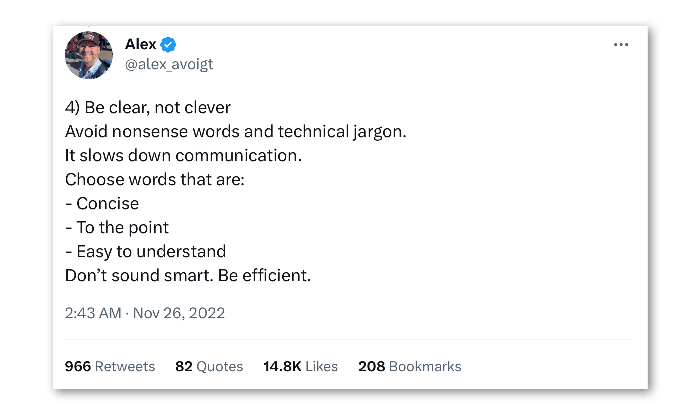
Drop the fanciness, bells and whistles in favour of making your audience understand what you're saying.
And that's it.
If you filter each piece of content you create using these 3 prompts, you'll be on your way to consistently hit your Sweet Spot.
Troubleshooting
What happens when it doesn't align?
There are 3 "pitfalls" within the Content Trinity, and if you find yourself there, you'll likely end up with burnout and resentment for not getting the results you'd hoped for with your content.
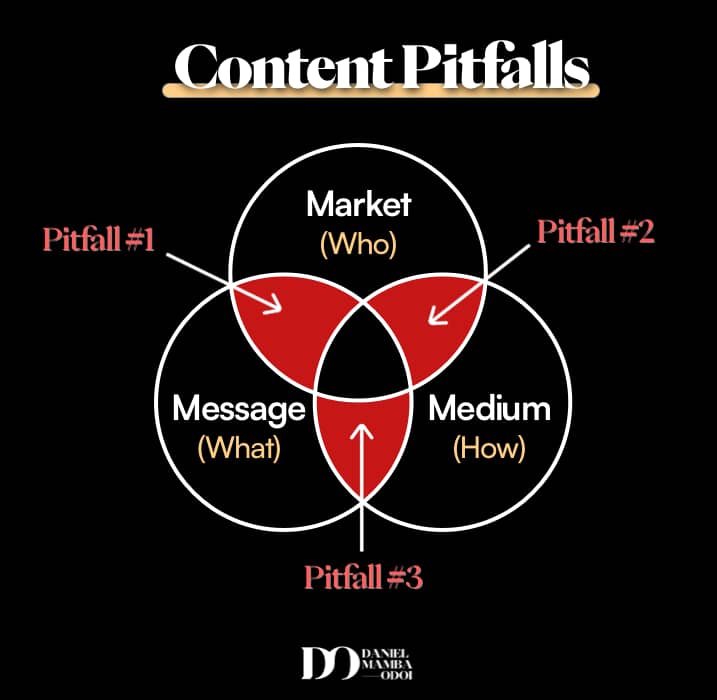
Pitfall #1: Not visible
✅ Message
✅ Market
❌ Medium
Your content is clear on its purpose and focused on serving your audience, but it isn't being delivered in a way that your audience currently consumes, and hence you're not visible to them.
You're stuck spinning your wheels in obscurity, meaning you'll never be discovered or able to impact your audience.
To get out of this pitfall — engage with your audience directly (i.e. survey, 1:1 call) to understand how they prefer to consume content and then adapt your content formats to align with those.
Pitfall #2: Not clear
❌ Message
✅ Market
✅ Medium
Your content is very audience-centric, except there's no clarity over the intention or outcome of each piece of content, and it reflects in the confusing or conflicting messaging.
Scattered focus = Scattered results.
You're doing a 'spray and pray' approach towards content and hoping that by posting repeatedly, you'll get more reach, gain more followers or convert it into more sales.
To get out of this pitfall — zoom out and audit your past content. With an objective stance, ask yourself:
"What was the point of that piece of content?"
If you need to, revisit your Content Funnel and have that alongside you each time you create content so you're clear in your mind about what its role is.
Pitfall #3: Not relevant
✅ Message
❌ Market
✅ Medium
You're jumping on the hottest content trends or opportunities, but as a result, you're sacrificing relevance to your specific audience.
Even if your audience sees your content, they don't feel like you're talking directly to them or understand where they're at.
Instead, you're just pandering to "virality" or making "selfish" content—i.e. content that doesn't serve your audience, solve their challenges or strokes your own ego (yes, I've been guilty of doing this).
To get out of this pitfall — get out of your head, and put yourself in the shoes of a person in your ideal audience and ask yourself:
"Why should they care about my content? How is it improving their life?"
With your audience (not your ego) front-of-mind, you'll start creating content that connects.
So in summary, ask yourself these 3 questions for each piece of content you create:
- Message: What is the purpose of this content?
- Market: Who is the audience for this content?
- Medium: How are you delivering it?
Mamba