On the surface, planning your year might seem like an optional task—something the "productivity obsessed" do while the rest of us wing it.
But I've lived both sides of that equation. For 25 years, I steered my life without a rudder. Just reacting, hoping I'd somehow arrive at my destination. It wasn't until I hit rock bottom that I realized: without a plan, you don't navigate your life. Your life navigates you.
Use Your Past To Inform Your Future
Become a good student of your own life. It's the information you are most familiar with and feel the strongest about, so make your own life one of your most important studies.
In studying your own life, be sure to study the negative as well as the positive, your failures as well as your successes. Our so-called "failures" serve us well when they teach us valuable information. They're frequently better teachers than our successes.
— Jim Rohn
Once you complete an annual reflection, the next step is translating those insights into concrete plans for your future. Use that momentum to turn lessons into action.
I polled my Instagram community recently about their planning process. Nearly 70% responded that they either haven't written anything down or don't know where to start.
If that's you, I've got you.
My Quarter-Life Crisis
If you don't know where you're going, you'll end up someplace else
— Yogi Berra
During my early 20s, I let so many years pass without any clear intention or sense of what I truly wanted for my life.
Sure—I was "productive." But it felt like I was productive in a million different, unrelated things that weren't moving me toward what was actually right for me.
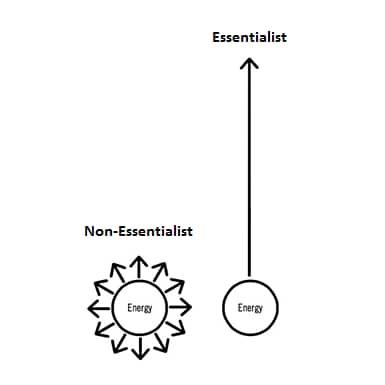
In fact, I had never actually sat down to ponder and write down what the vision for my life was.
If you don't create a routine, you will be assigned one.
If you don't create a purpose, you will be assigned one.
If you don't create a career, you will be assigned one.
People are too quick to adopt the structure that somebody else created to ease life's uncertainty.
— Dan Koe
By the time I was 25, externally it looked like I was ticking all the right boxes. I was an Operations Manager at Uber Australia, living an exciting Sydney lifestyle, and managing a thriving community.
But I wasn't fulfilled. I was lost. And I wasn't where I wanted to be.
So I made a bold move: I resigned from Uber, pursued a travel opportunity in Europe, and used it as a springboard for my personal brand.
Just 4 weeks into the trip, I received a phone call. My father had passed away from a sudden heart attack.
I was yanked back into reaction mode. The months that followed were a mess. I was grieving, managing family affairs, and being pulled in a million different directions—completely adrift once again.
Timely Teachers
When the student is ready, the teacher will appear
— Lao Tzu
Desperate to regain control, I gravitated toward three books that had been sitting unread on my shelf for years:
- The 7 Habits of Highly Effective People — Stephen R. Covey
- Start With Why — Simon Sinek
- Think & Grow Rich — Napoleon Hill
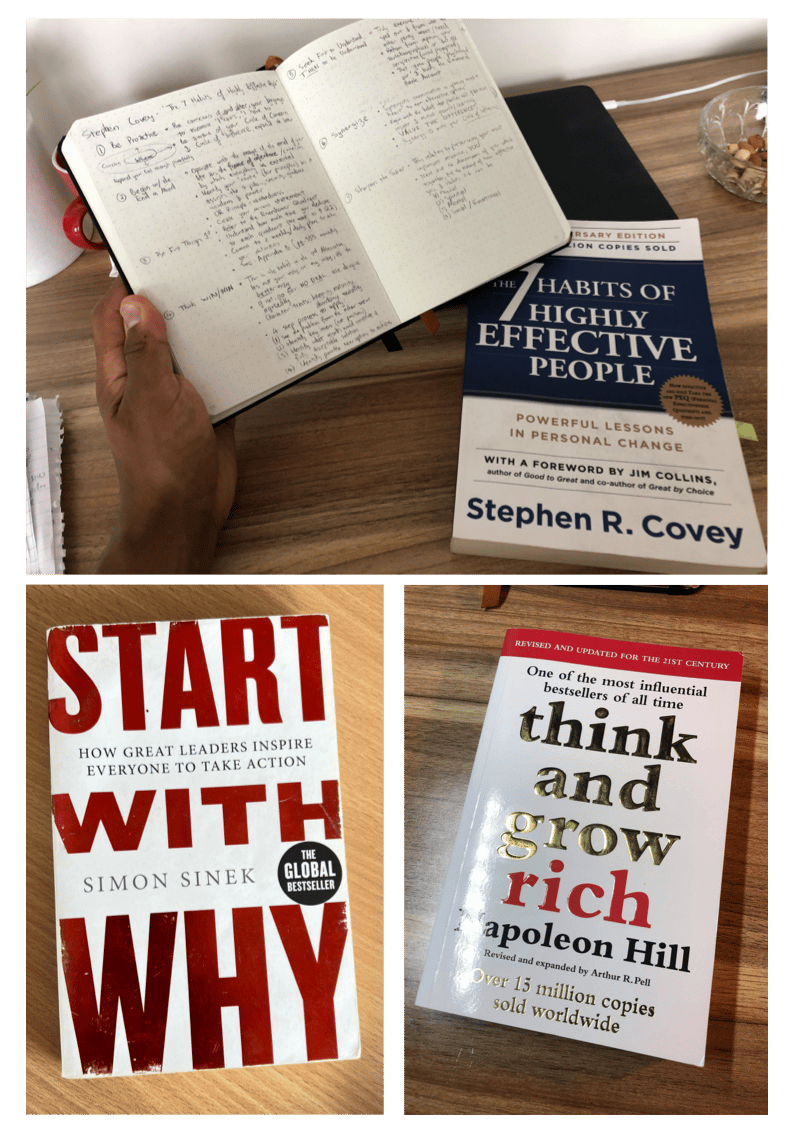
It's remarkable how the right books, people, and experiences seem to appear exactly when you need them most. The lessons and mindset shifts they sparked formed the foundation of how I finally started planning my life, one year at a time.
My First Annual Game Plan
In late 2019, I created my first annual game plan using Google Sheets. I still remember how proud I felt for finally creating a map for my life. I felt inspired. Empowered. Like I finally had a tangible vision.
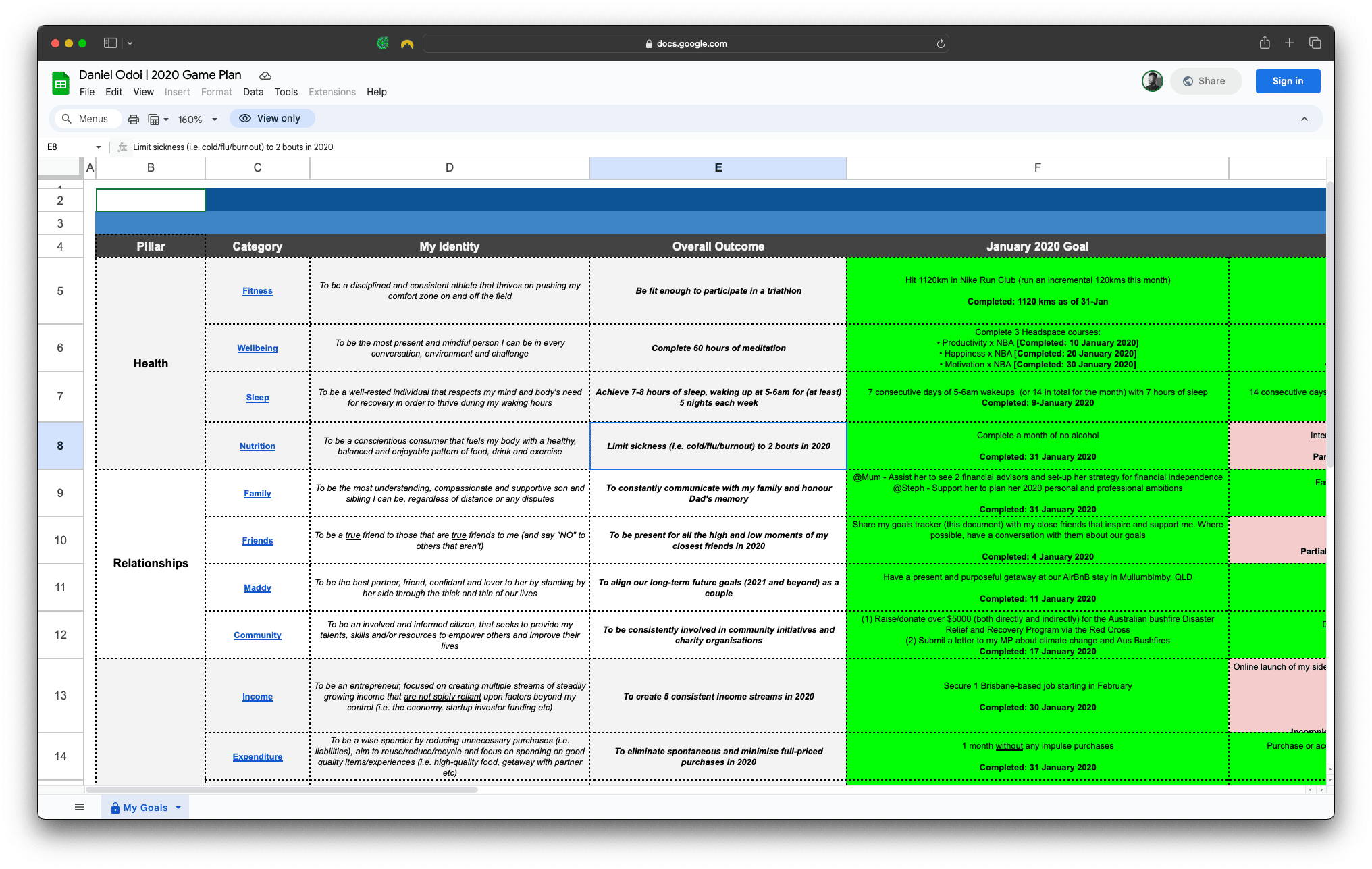
And I want you to feel the same.
The framework is simple. It's made up of just three elements:
- Pillar & Categories
- Why & Identities
- Outcome & Sprints
Let's map out your plan.
Pillar & Categories
Where you are headed is more important than how fast you are going. Rather than always focusing on what's urgent, learn to focus on what is really important.
— Stephen R. Covey
Pillars are the key areas of your life—the areas that matter most to you. They're a useful way of grouping and organizing what you'll focus on according to an overarching theme.
Pick 3-5 themes you want to plan for. For example:
- Health
- Wealth
- Relationships
- Career/Business
- Hobbies
Categories are like sections within each pillar, breaking each area of your life into 3-5 discrete parts.
For example, under the pillar of "Health," you might break that down into:
- Exercise & Mobility
- Nutrition & Hydration
- Sleep & Recovery
Don't worry if you haven't covered every category in your initial draft. You can always edit, add, or remove sections that don't feel right for you.
Then do this for each pillar until you're happy with what you have.
Why & Identities
❓ Your Why
Regardless of WHAT we do in our lives, our WHY—our driving purpose, cause or belief—never changes.
— Simon Sinek
I've found that goal-setting becomes more inspiring, and importantly, more resilient, when you've got a compelling why.
When life gets hard—and it will—a clearly defined why is what picks you up after being knocked down.
I recommend you write a corresponding reason why each category matters to you. This is also a good test to validate whether all your categories actually matter to you or not.
For example:
Pillar: Health
-
Exercise & Mobility — So that I'll have the energy to keep up with my kids/grandkids and avoid ending up in a wheelchair
-
Nutrition & Hydration — So that my body is optimized to look, feel, and perform its best so I can serve others at my best
-
Sleep & Recovery — So that I have the energy and stamina to give 100% to all the projects, people, and passions that matter most to me
👤 Your Identity
A human being always acts and feels and performs in accordance with what he imagines to be true about himself and his environment.
— Maxwell Maltz
This invites you to visualize and define the version of you already living in alignment with your idealized self.
Most people focus only on the doing. But first must come the being. Your thoughts, behaviors, and actions are driven by the self-image you hold of yourself.
Regularly referring to a clearly defined identity helps you embody that version of yourself today, so that all future actions are filtered through the lens of your identity.
For example:
Pillar: Health
-
Exercise & Mobility — I am active, disciplined, and consistent in my workouts and stretching routines, which are enjoyable, suit my lifestyle, and challenge me to improve every time
-
Nutrition & Hydration — I am eating a diet comprising 80%+ organic, unprocessed, and/or fresh foods and have cut out alcohol and sugary drinks
-
Sleep & Recovery — I am consistently going to bed and rising at the same times and prioritize regular sauna and massage sessions
It's okay if you're not living this way today. Because now, your future decision-making becomes easier by asking:
"What would that version of me do in this situation?"
Outcome & Sprints
You either control your mind or it controls you. There is no halfway compromise. The most practical of all methods for controlling the mind is the habit of keeping it busy with a definite purpose backed by a definite plan.
— Napoleon Hill
🎯 Outcome
This is about setting goals that align with the identities you wish to embody.
Pick goals that excite you (light you up) and slightly scare you (overwhelm you). These are the catalyst to shift you from where you are to where you want to be.
If you've struggled with goal-setting before, I recommend learning about SMART goals:
SMART goals are:
- Specific
- Measurable
- Achievable
- Relevant
- Time-Bound
For example:
Pillar: Health
- Exercise & Mobility — Complete the Great Ocean Road Half Marathon (21km) in under 1 hour and 40 minutes in May

🗓️ Sprints
Now that you've crafted SMART goals for each category, you can:
(1) Break the goal into smaller time intervals such as monthly or weekly "sprints"; and
(2) Decide on the habits you'll commit to on a daily basis during a sprint.
For example:
Pillar: Health
- Exercise & Mobility — Run 5km on 3 days per week, and stretch for 30 minutes on the other 4 days of the week, for January
Depending on what suits you, you can:
- Schedule time for your habits into your calendar
- Set a daily/weekly reminder to keep you on track
- Create a digital or printed tracker to tick off completed actions
When I first started tracking my habits at the start of 2020, I used a combination of James Clear's Habit Journal and my Google Calendar.
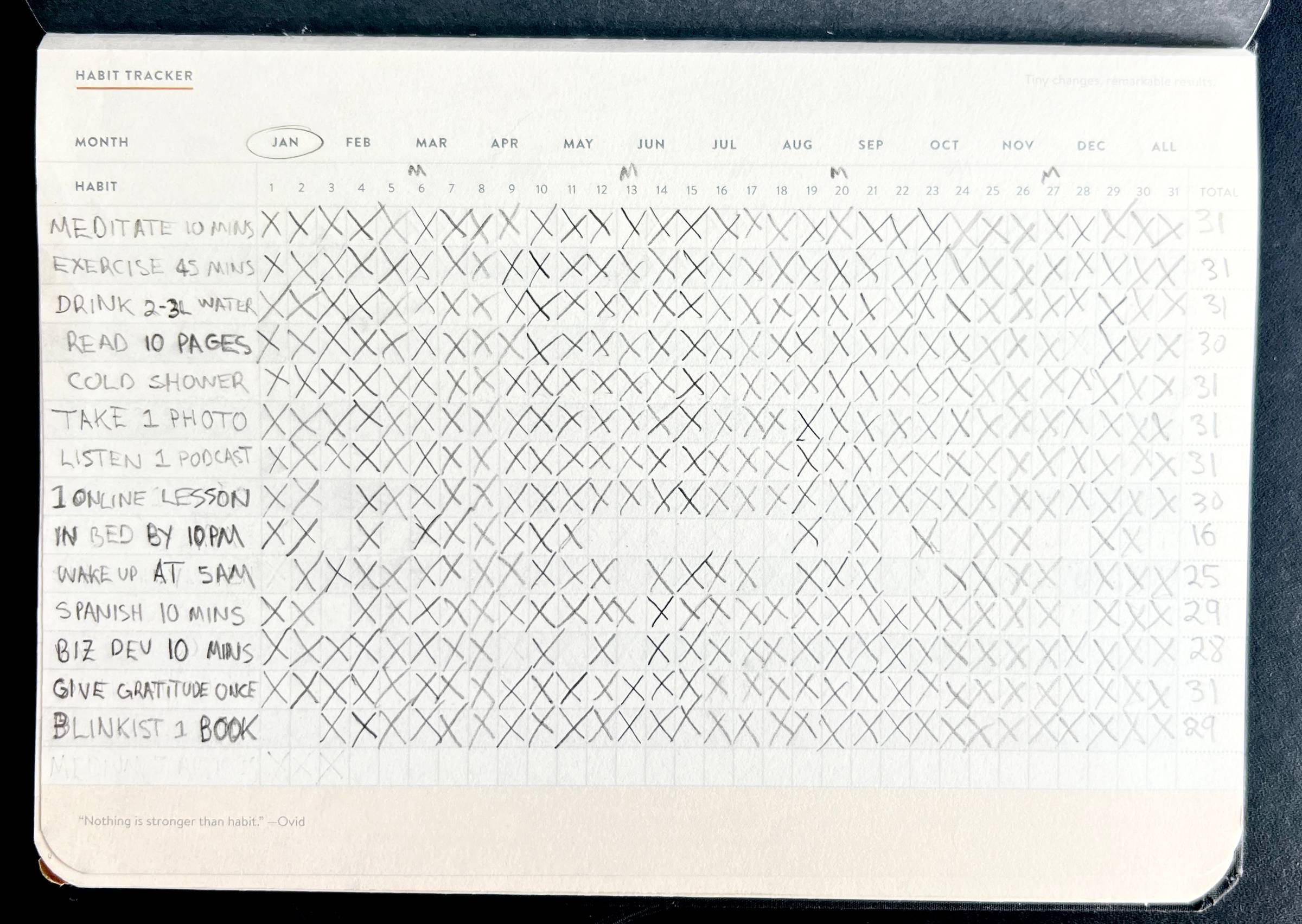
Ultimately, set up a system that you can sustain and that works for you. Because I cannot overstate how much this annual process has positively impacted me.
Something that takes just a couple of focused hours each year could be the difference between the life you have right now and the life you desire.
So, in summary, to plan your year:
-
Pillar & Categories — Decide the areas that matter most to you and break them down into the relevant categories
-
Why & Identity — For each category, define why it matters to you as well as the standards you need to embody to become that version of yourself
-
Outcome & Sprints — Craft SMART goals for each category and translate those into "Sprints" with daily trackable habits
Mamba